
How to decode in the exam room
Let's decode this week's trap: what's going on in your head, and on your notepad, in the exam room.
You’ve seen the Harbour Foods trap in this week’s Shorts. Sophie signs a £140,000 contract on her own. The articles say two directors must sign. And ColdChain’s account manager knew all about the two-signature rule.
Is Harbour Foods bound?
This week, I want to imagine it with you from the inside: the kind of thing going through your head, and what you can get down on your notepad in the exam room itself. If you thoroughly practise this cognitive instant-recall habit now, using your Rapid Recall Map, you’ll be as confident as you can ever be: now, and on exam day.
🎧 Prefer to listen? Here's the full 11-minute episode:
Can't see the player? Listen to the episode here →
Trace down, out loud (silently)
“Out loud” in an exam means mouthing it. Talk it to yourself. Then trace down your Rapid Recall Map, through all the law you’ve learnt, on your way down the ladder.
For Harbour Foods, it might go something like this:
- Business law
- → Companies
- → Directors
- → Directors’ authority to bind the company
- → Limits on that authority in the constitution (here: two signatures, in the articles)
- → Who’s on the other side: an insider or an outsider?
- → An outsider, dealing in good faith: section 40
And alongside it, everything that lives nearby: knowing (bad faith), later ratification by the company, section 41 insiders, and ostensible authority.
Where you should land: section 40, contracts with third parties, outsiders, dealing in good faith.
Then jot it down: your Sticky Phrases
Drop down a few keywords or short phrases. These are your Sticky Phrases: short enough to remember while you study, and to jot down in seconds on the day. First, the rule in a few words:
- The articles don’t matter to outsiders. The two-signature rule is purely an internal matter.
- s.40 protects the outsider. In favour of a person dealing with the company in good faith, the directors’ power to bind the company is treated as free of any limit in the constitution (the articles of association and its own internal rules).
- Good faith is presumed (s.40(2)(b)(ii)).
- Knowing the limit isn’t bad faith on its own (s.40(2)(b)(iii)).
That’s why the facts go out of their way to tell you what the account manager knew and believed. ColdChain did know Sophie needed a second signature. But knowing about the limit isn’t enough. Bad faith would need something more, like knowing Sophie was deliberately going behind the board’s back, or acting dishonestly. And the burden of proving that would be on Harbour Foods.
The facts make you feel ColdChain did something wrong. The law says knowing the limit isn't the same as bad faith.
This week's Sticky Phrases
Now boil the rule down to lines that stick. Here are mine for this trap. Borrow them, or better still, make your own:
- “Indoor rules don’t bind outdoor people.” The articles (like the two-signature rule) are an internal matter. Outsiders aren’t caught by them.
- “Good faith is presumed. Bad faith is proved.” The outsider starts in good faith; the company has to prove otherwise.
- “Knowing isn’t scheming.” Knowing about the limit isn’t bad faith on its own.
- “Forty for outsiders, forty-one for insiders.” Section 40 protects the outsider. Section 41 catches deals with directors and their connected persons.
- “Connected? Then it’s forty-one.” If the other side is a director’s company, you’re in a different box.
Trap Territory: the neighbours you passed
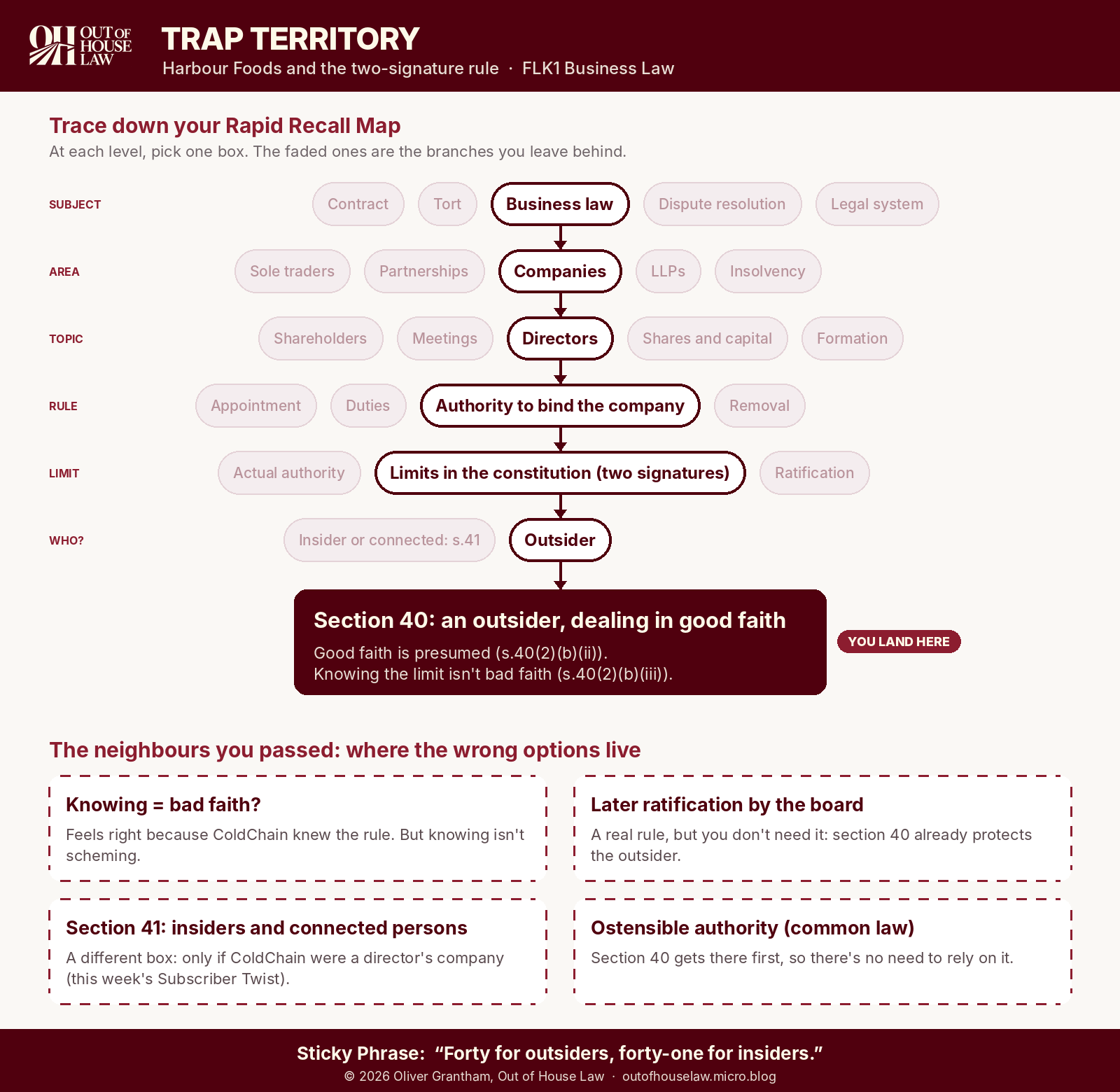
When you arrive at section 40 on your map, you’ll know its closest neighbours:
- Knowing, in bad faith
- Later ratification by the board
- Section 41, insider contracts (which doesn’t apply here)
- Ostensible authority under the common law (s.40 overrides that, so no problem there)
Here’s the thing. With any question, on any subject, the wrong options aren’t random. Most of the time, each one is a real rule from a neighbouring box on your map.
That’s why they feel familiar. “Oh yes, I remember something about that.” But unless you know it properly, you won’t necessarily see that it doesn’t apply to this question. To the untrained, not-quite-prepared candidate, that’s the trap.
So go back to the lead-in. You’ve done your Rapid Recall Map. You’ve traced down. You’ve looked at the nearest neighbours. You’ve already spotted the wrong options before you’ve even read them.
🔓 This week's Subscriber Twist
Same facts, one detail changed:
What if ColdChain was owned by one of Harbour Foods’ own directors?
What are your thoughts on that? Different box, different outcome, different answer. Which is exactly why the Rapid Recall Map, and tracing down it, really matters.
Have a go before you read on.
Show the answer
Now you're in a different box: section 41. ColdChain is a person connected with one of Harbour Foods' directors (a company in which the director has at least a 20% stake: ss.252–254). Section 40 can't rescue an insider deal like that, so the contract is voidable at Harbour Foods' option.
I’d love to know what you think.
Why drilling isn't enough
I get why you do it. I’ve heard of candidates drilling themselves with thousands of questions.
It trains pattern recognition. And, in a very inefficient way, it eventually trains you to guess what the examiner might be thinking. But it isn’t foolproof, and it isn’t 100% accurate. It trains pattern recognition, not proper legal understanding.
The four moves of The Decoder Method, which I’m teaching you and which you’ll get better, faster and more efficient at, mean you can do fewer questions, learnt with the law behind them, learnt better.
If you learn the law properly, the method gets it out under exam pressure.
And remember: in a single best answer question, the story can accidentally support a wrong option. You can be completely prepared, but if you go through all the facts before the lead-in, you can easily get swayed by the wrong option. Going back to the lead-in protects you from that.
Quick-fire tips
- Keep a Trap Diary of every trap you meet. If you’ve downloaded my free guides, you’ll see it’s all set out for you.
- Five questions done properly beats fifty on autopilot. Apply the four moves, properly.
- Space your reviews: day one, day three, week one, then revisit after week three.
- Explain it to a client. If you can explain it out loud, accurately and with confidence, as you would to a real-life client, you’ve got the knowledge, the application and the confidence to absolutely smash it in the exam.
The Study Guide and the Revision Guide work in tandem: the Study Guide to learn the law in the right frame, the right way, for the exam you’re going to face; the Revision Guide focused on the exam mindset you’ll take in there with you.
Your turn
Out of the four moves you went through on this question: which one made it click? Which helped the most? What made the right answer stand out for you? And how confident did you feel doing it that way?
Your answer will help me help you, and many others, refine these four moves. Hit reply and drop me a line. Say hello and tell me.
🔓 Subscribers only: your full Oliver's Quick-Fire set for the family home is here → Take the full quiz. Know someone revising? Send them the free 5-question taster.
Coming up: the Intestacy Study Guide and Revision Guide go on sale next Tuesday, 1 December.
And if you haven’t already, get my free Study Guide and Revision Guide on Trusts of the Family Home:
Get the free Study and Revision Guides →
Wishing you all the very best with your studies and exam preparation, until next week.
And remember: no firm behind you? Now you’ve got me.
Oliver